
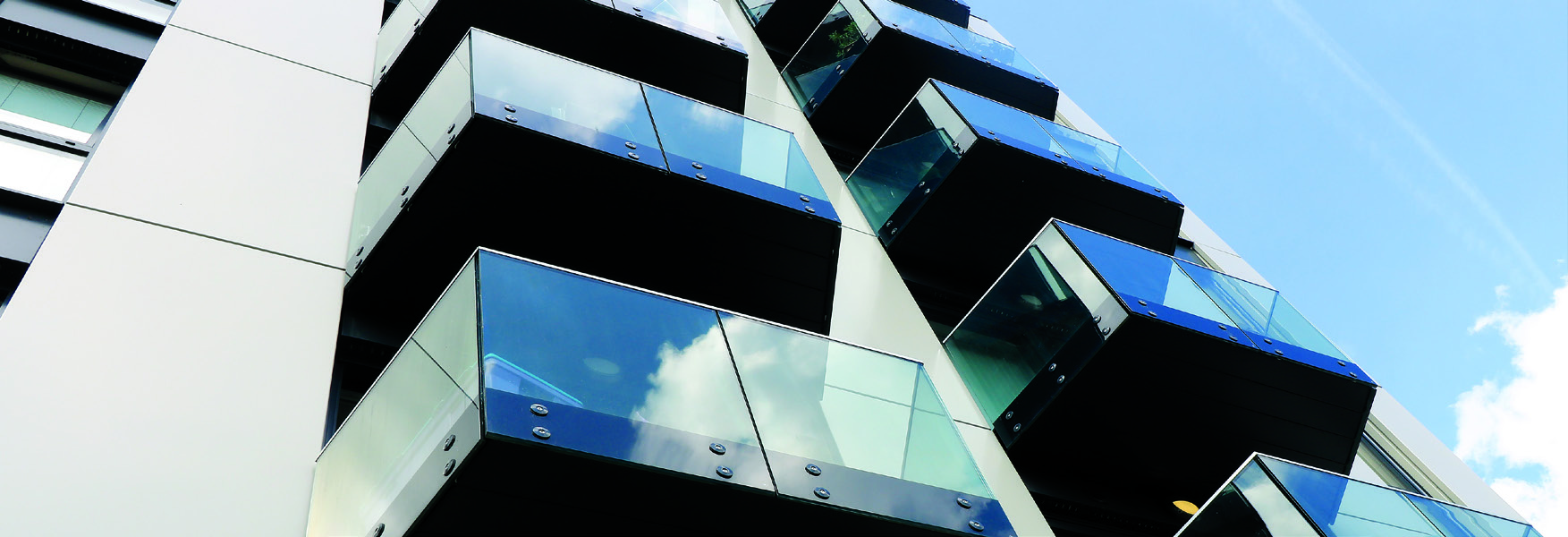

The increase in urbanisation and economic growth in cities leads to a disproportionately high population density compared to suburbs and countryside. Having such a concentrated number of people in a small space has a consequence on the environment and the carbon footprint of a city. Most notably, a high level of air conditioning in high-rise buildings, due to it being very difficult to ventilate at height. Emissions are only set to increase as environments heat up.
Balconies and energy efficiency
There is a common misconception that balconies do very little to the energy efficiency of a building. Most people think they are an added extra with no significant part to play in saving or producing energy. Balconies, however, can contribute highly to energy efficiency by harnessing energy from the sun and wind. The benefits depend on climate, the building’s aspect and height and the effects of the wind in the area but giving this some thought in the design phase can make a big difference.
A glazed balcony, for example, can create solar gains for the apartment in a cold climate. In warmer climates with greater ventilation needs, residents can use the balcony as a buffer zone and regulator between indoor and outdoor temperatures. Vegetative balconies act as air filters and heat absorbance. This is particularly useful for buildings in the centre of built up areas with less clean air.
Higher buildings can get more light, but ventilation can be an issue the higher up the apartment is.
The optimum dimension, height and position for balconies affects their potential energy efficiency too. Beyond 20 storeys buildings can lose energy efficiency rapidly, so it’s important to harness as much of the surrounding climate as possible. Depending on the size and orientation of a balcony, there is a potential to save up to 80% energy over the lifetime of the building.
Another great example of using material choices for balconies to reduce other energy requirements is solar shading. This benefits buildings in hotter climates, as designers can use the shade from a balcony at the right distance from the ones below and above to create shading.
A lifetime calculation
When we think of the overall carbon footprint of a balcony, we must consider the construction as well as operations energy. There is of course carbon embedded in the production of a balcony, with the cost of energy in materials and assembly and materials used must be assessed for their overall carbon footprint. Concrete is less efficient than aluminium for instance, both in its construction, its creation of thermal breaks and its inability to be recycled.
A positive way forward is to understand how much of an impact buildings have on the climate over their lifetime. To measure this, it’s important to implement BIM and performance analysis to capture the true carbon output of a building from design to operation.
“Balconies can contribute highly to energy efficiency by harnessing energy from the sun and wind.”
“When we think of the overall carbon footprint of a balcony, we must consider construction as well as operations energy.”